Meta Description: Learn how to lower the cost of custom stand-up pouches through smarter material selection, printing strategy, design optimization, and ordering practices. Expert insights from Sorbar packaging serving brands since 2015.
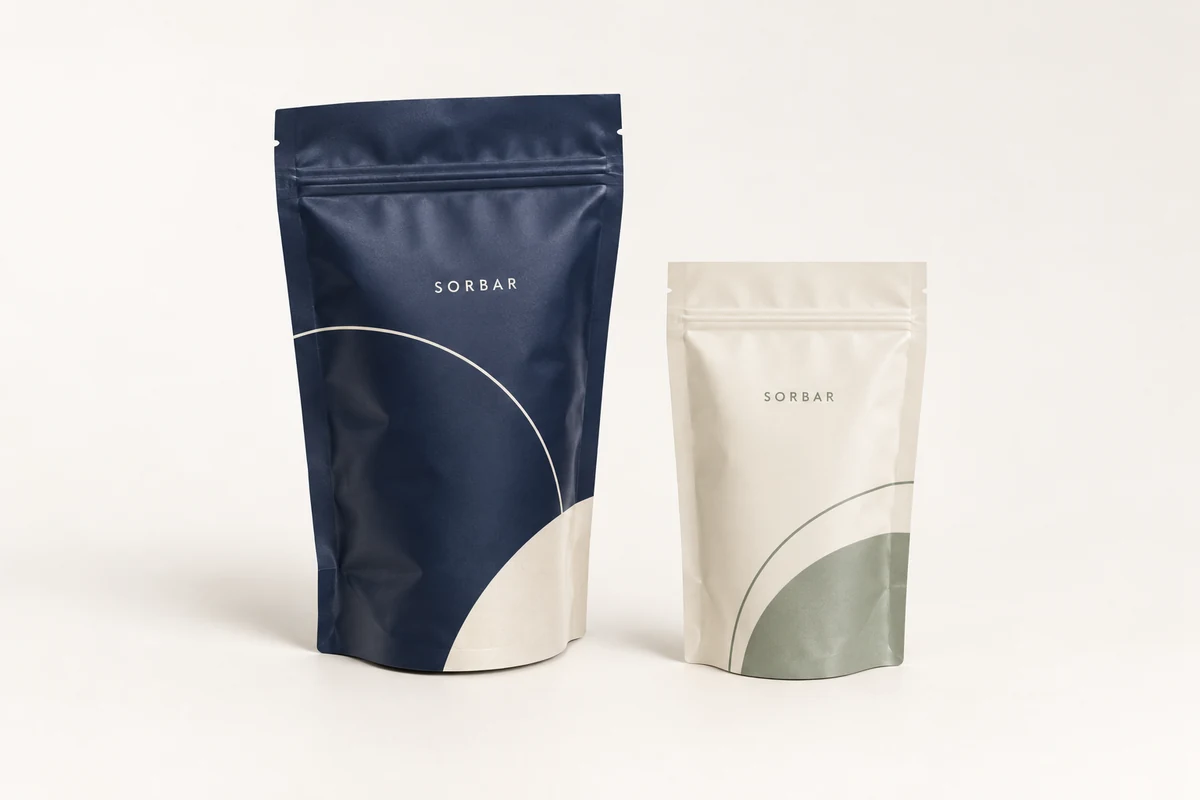
Stand-up pouches have reshaped retail packaging. They stand out on shelves, protect products effectively, and use far less material than rigid containers such as glass jars, metal tins, or plastic tubs[^1]. For growing brands, they offer a high-impact branding canvas.
Yet many brand owners hesitate before committing to fully customized pouches. The concern is understandable. Cylinder charges, unfamiliar material options, and quotes that vary widely between suppliers can make custom packaging feel expensive and unpredictable.
After working with food, pet food, and consumer goods brands across North America, Europe, Japan, and Australia since 2015, we have seen the same pattern repeatedly. Most brands overspend on packaging not because customization is inherently expensive, but because of avoidable decisions. These include over-specified materials, mismatched printing methods, fragmented SKU ordering, and features that add cost without adding value.
This guide explains where your packaging budget actually goes and how to reduce it, without sacrificing shelf appeal, product protection, or compliance.
First, Understand Where Your Money Goes
You cannot control costs you cannot see. The unit price of a custom stand-up pouch is typically built from five components:
| Cost Component | What It Includes | How Much You Can Influence It |
|---|---|---|
| Materials | Laminated films (PET, PE, VMPET, foil, kraft paper), adhesives, inks | High: often the largest share of unit cost in larger runs |
| Printing setup | Rotogravure cylinders (one per color), color matching, proofing | High: driven by color count and SKU count |
| Converting | Lamination, curing, slitting, pouch making | Medium: affected by pouch style and complexity |
| Functional features | Zippers, spouts, valves, windows, special finishes | High: every add-on carries a cost |
| Logistics | Packing, cartons, freight, duties | Medium: affected by pouch size, weight, and lead-time planning |
Two observations matter here:
- On small runs, setup costs dominate. Cylinder charges spread across 3,000 pouches weigh heavily on each unit. Spread across 50,000, they become almost negligible.
- On large runs, materials dominate. Once setup costs are absorbed, film structure and thickness have the greatest effect on your unit price.
Every strategy below targets one or more of these components.
Strategy 1: Specify the Right Material Structure, Not the Most Impressive One
Over-engineering the material structure is the single most common cause of inflated pouch costs. Many brands default to an aluminum foil laminate because it offers maximum protection, even when their product has a six-month shelf life and only moderate moisture sensitivity.
The goal is to match barrier performance to your product's actual requirements. The table below shows common structures and their typical applications:
| Typical Structure | Barrier Level | Best Suited For |
|---|---|---|
| PET / PE | Moderate | Dry goods with short-to-medium shelf life, non-food items, bath salts, hardware |
| PET / VMPET / PE | High | Snacks, granola, dried fruit, many pet treats |
| Transparent high-barrier PET (AlOx / SiOx) / PE[^2] | High (with product visibility) | Products where a clear view is a selling point |
| PET / AL / PE | Very high | Coffee, powdered supplements, oxygen-sensitive foods, long shelf-life products |
| Kraft paper / VMPET / PE | High | Natural and artisan brands seeking a paper look |
| Mono-material PE (recyclable)[^3] | Moderate to high | Brands targeting recyclability claims in Europe and North America |
Practical Cost-Saving Moves
- Consider VMPET before foil. Metallized PET delivers excellent oxygen and moisture barrier properties[^4] for many dry food and pet treat applications, at a lower cost and lighter weight than aluminum foil.
- Optimize film thickness. Total pouch thickness often falls in the 100–150 micron range, but the right gauge depends on fill weight and product characteristics. A 500 g bag of granola does not need the same structure as a 5 kg bag of kibble. Reducing thickness by even 10–20 microns, where performance allows, can noticeably reduce material costs on high-volume orders.
- Test before you commit. A reputable supplier should provide samples so you can run fill tests, drop tests, and shelf-life trials before mass production.
Our advice: Share your product type, fill weight, target shelf life, storage conditions, and destination market with your supplier. A good packaging engineer will recommend the most economical structure that meets your requirements, not the most expensive one available. Contact our packaging specialists today for a free consultation, a cost-optimized material recommendation, and a custom quote tailored to your product. .
Strategy 2: Choose Pouch Style and Dimensions Strategically
Pouch Style Affects Cost
Not all pouches cost the same to produce:
- Standard stand-up pouches (Doypack style): The most economical choice for most retail products up to around 1 kg.
- Flat bottom pouches (box pouches): Premium shelf presence and five printable panels, but more complex to produce and generally more expensive. They are well justified for premium pet food and specialty coffee, but they are not always necessary for smaller fill weights.
- Side gusset pouches: Efficient for larger volumes and coffee, often at a lower cost than flat bottom pouches.
- Shaped (die-cut) pouches: Eye-catching, but they require custom cutting dies and generate more material waste.
Dimensions Affect Material Efficiency
Pouches are produced from wide rolls of laminated film. Your pouch dimensions determine how efficiently that film is used:
- Choose common, proven sizes where possible. Standard sizes are typically optimized for material utilization, compatible with standard zippers, and easy to fit onto common filling machines.
- Avoid oversizing. Many brands add excess headspace "just to be safe." Filling a sample pouch with your actual product often shows the bag can be reduced by 1–2 cm in width or height. That is a direct material saving on every unit.
- Keep dimensions consistent across a product line. If multiple SKUs share the same pouch size, you can consolidate production runs and simplify inventory. This becomes especially valuable when combined with the printing strategies below.
Strategy 3: Match Your Printing Method to Your Order Volume
Printing method is one of the most decisive cost factors, and also one of the most misunderstood. At Sorbar Packaging, we offer both digital printing and rotogravure printing, which allows us to recommend the most economical option for each project rather than steering clients toward the only process we offer.
Digital Printing
- No cylinders or plates required, which eliminates setup costs
- Ideal for short runs, product launches, seasonal editions, and multiple SKUs in small quantities
- Supports unlimited colors and variable designs at no additional setup cost
- Fast turnaround for market testing
- Higher unit cost than rotogravure at larger volumes
Rotogravure Printing
- Requires one engraved cylinder per color, which is a one-time investment that can be reused for repeat orders
- Delivers exceptional print quality, rich color saturation, and consistency across long runs
- The lowest unit cost at medium to high volumes
- The industry standard for high-volume flexible packaging
(Flexographic printing is another option used in some markets for medium-to-long runs[^5]. For most premium laminated stand-up pouches, however, rotogravure remains the preferred choice for print quality and consistency.)
Where Is the Break-Even Point?
There is no universal number. The crossover point depends on pouch size, number of colors, and number of SKUs. As a general guide, digital printing is usually more cost-effective for runs below several thousand units per design, while rotogravure becomes clearly more economical once quantities reach the tens of thousands per design, especially for reorders, when cylinder costs no longer apply.
The Hybrid Strategy: Launch Digital, Scale with Gravure
For growing brands, the smartest approach is often a combination of both:
- Launch with digital printing to test designs, flavors, and market response without investing in cylinders.
- Identify your best-selling SKUs after the first few months of sales data.
- Transition proven SKUs to rotogravure to secure the lowest unit cost for ongoing reorders.
- Keep slower-moving or seasonal SKUs on digital to avoid tying up capital in excess inventory.
Case Study: A Specialty Snack Brand in Germany
A mid-sized snack brand planned to launch eight new flavors in the European market and initially requested rotogravure quotes for all eight designs at 10,000 pieces each. Cylinder costs alone for eight 8-color designs represented a significant upfront investment, and the brand had no sales data to show which flavors would succeed.
We recommended producing all eight flavors with digital printing at 3,000 pieces each. After one quarter, three flavors accounted for most of the sales. Those three moved to rotogravure at 30,000 pieces each, while the remaining five stayed on digital in smaller quantities.
Result: The brand avoided cylinder investment on underperforming flavors, reduced overstock risk, and achieved a substantially lower unit cost on its core products.
Strategy 4: Design With Production Costs in Mind
Good packaging design and cost-efficient design are not opposites. A few production-aware decisions at the artwork stage can lower costs significantly, particularly for rotogravure printing.
Reduce the Number of Colors
In rotogravure, each color requires its own cylinder. A design with ten colors costs more to set up than one with six.
- Combine CMYK process colors with only one or two essential spot colors, such as your brand's signature color, instead of using many separate Pantone colors.
- Ask your designer whether subtle color variations can be achieved through screening rather than additional spot colors.
Share Cylinders Across Multiple SKUs
This is one of the most powerful and most overlooked cost-saving techniques for brands with product lines:
- Design a common master layout shared across all variants, including logo, brand colors, background, and nutrition panel structure.
- Change only one or two "variant" colors or text elements per SKU, such as flavor name or accent color.
- Only the variant cylinders need to be engraved for each new SKU. The shared cylinders are reused.
Case Study: A Premium Pet Food Brand in North America
A natural pet food manufacturer was preparing six recipes in flat bottom pouches. Their original artwork used a completely different color palette for each recipe, which would have required a full set of cylinders for every SKU.
Working with their design agency, we restructured the artwork. All six recipes now share the same brand background, logo, and back-panel layout, with each recipe distinguished by a single accent color and its recipe-specific text.
Result: Most cylinders are shared across the entire range. Each new recipe requires only a small number of additional cylinders, significantly reducing setup costs for the launch and making future line extensions far more affordable. Shelf appeal improved as well, because the unified design created a stronger brand block on retail shelves.
Use Special Finishes Selectively
Matte finishes, spot gloss varnish, soft-touch coatings, and hot stamping can elevate a design. But each one adds cost.
- Matte or gloss as a full finish is usually a cost-effective way to achieve a premium look.
- Spot effects, such as matte with gloss highlights, add a process step. Use them only where they create real impact, such as on the logo or product name.
- Use white space with intent. Clean, minimalist designs with purposeful negative space often look more premium than crowded layouts[^6], and they are easier to reproduce consistently.
Consider Stock Pouches With Custom Labels for Small SKUs
For very small batches, sample packs, or products with frequent formula changes, plain or generically printed stock pouches combined with custom labels can be the most economical option. This works particularly well for limited editions, trial sizes, and wholesale or B2B channels where retail shelf appeal is less critical.
Strategy 5: Pay Only for Features That Earn Their Place
Functional add-ons can improve the consumer experience, but they also increase unit cost. Evaluate each one against your product's real needs and your customers' expectations.
| Feature | Cost Impact | When It's Worth It |
|---|---|---|
| Tear notch | Minimal | Almost always. It improves opening and adds negligible cost. |
| Hang hole (round or euro slot) | Minimal | When products are displayed on retail hooks |
| Rounded corners | Low | Improves appearance and safety at little extra cost |
| Standard press-to-close zipper | Moderate | Products consumed over several uses, such as snacks, pet treats, and supplements |
| Pocket zipper / slider zipper | Higher | Large-format pet food bags and premium positioning. Valued by consumers for heavy bags. |
| One-way degassing valve | Moderate | Essential for freshly roasted coffee. Unnecessary for most other products. |
| Clear window | Low to moderate | When product visibility drives purchase decisions. Note that a window may limit some high-barrier structure options. |
| Spout | Higher | Liquids, purees, and baby food |
Key question to ask: Does this feature solve a real consumer problem or support a purchase decision? If not, it is likely an unnecessary cost.
For example, single-use products such as sample sachets or portion packs rarely need a zipper. A simple heat seal with a tear notch is both effective and economical.
Strategy 6: Order Smarter, Not Just Bigger
Larger orders generally reduce the unit cost. However, "order more" is only good advice if the inventory sells. Overstock ties up working capital, occupies warehouse space, and becomes waste when artwork or regulations change.
Smarter Ordering Practices
- Forecast at the product-line level. Share your annual volume estimates with your supplier, even if you place orders quarterly. This allows better material planning and pricing.
- Consolidate SKUs into the same production run. Ordering multiple designs that share the same material structure and size at the same time improves production efficiency and can lower costs.
- Plan lead times to avoid rush charges and air freight. Emergency orders are among the most expensive packaging mistakes. Air-freighting pouches because of a missed reorder date can erase the savings from a lower unit price. Building in enough lead time, particularly for sea freight, protects your margins.
- Prioritize reorders of existing designs. Reorders using existing cylinders avoid setup costs entirely. Minor artwork changes, such as a new barcode or date, often affect only one cylinder rather than the full set.
The Advantage of No Minimum Order Quantity
Many manufacturers impose high MOQs that force small and mid-sized brands to choose between overstocking and paying premium prices elsewhere. Sorbar Packaging has no minimum order quantity restriction. You can start with a small digital run to validate your product, then scale to rotogravure production as demand grows, all with the same supplier, the same quality standards, and consistent brand presentation.
Strategy 7: Look at Total Landed Cost, Not Just Unit Price
The lowest quote is not always the lowest cost. Experienced buyers evaluate total landed cost, meaning everything required to get usable pouches onto their filling line.
Logistics Efficiency
Flexible packaging has major logistics advantages over rigid packaging:
- Lightweight: Compared with rigid containers such as glass jars, stand-up pouches can reduce packaging weight dramatically, often by more than 80%, which lowers freight costs.
- Less material: Pouches typically use significantly less material by weight than comparable rigid containers.
- Shipped and stored flat: Thousands of empty pouches fit in the space required for a few hundred empty jars, which reduces both freight and warehousing costs.
You can improve efficiency further by optimizing carton packing and pallet loading with your supplier, especially for sea freight shipments.
The Hidden Cost of Poor Quality
A low price becomes expensive quickly when quality fails. Common issues with low-cost suppliers include:
- Weak seals or delamination, which cause leaks, product spoilage, and customer complaints
- Color inconsistency between batches, which damages brand recognition on the shelf
- Inaccurate dimensions, which cause problems on automated filling lines
- Missing or incomplete compliance documentation
For food and pet food brands, regulatory compliance is non-negotiable. Packaging for the US market must meet FDA food-contact requirements, while the EU requires compliance with regulations such as (EC) No 1935/2004 and (EU) No 10/2011 for plastic food-contact materials. A rejected shipment, recall, or the need to re-test packaging costs far more than the initial savings from a cheaper supplier.
Our advice: When comparing quotes, ask each supplier for material specifications, compliance test reports, and pre-production samples. Make sure you are comparing equivalent structures, thicknesses, and features, not just headline prices.
Strategy 8: Go Sustainable Without Breaking the Budget
Sustainable packaging is no longer optional for many brands, especially in Northern and Western Europe and coastal North America. But it is important to be realistic: certified compostable and bio-based materials generally cost more than conventional laminates. Their raw materials are more expensive, and their barrier performance can require careful engineering.
That does not mean sustainability has to be prohibitively expensive. Here is how to manage the cost:
- Consider recyclable mono-material PE pouches. These are often more cost-competitive than compostable alternatives and align with growing recyclability requirements in many markets.
- Choose compostable materials where they make the most sense, such as for products with shorter shelf-life requirements, where the material's barrier properties are sufficient.
- Use kraft paper laminates for a natural look. If your main goal is a natural, eco-friendly aesthetic, a kraft paper laminate can deliver that visual identity at a moderate cost. Be transparent with consumers about its actual end-of-life properties.
- Right-size and light-weight. Using less material is both the most sustainable and the most economical choice.
- Avoid unsubstantiated claims. Regulations on environmental marketing claims are tightening, particularly in the EU. Making claims your packaging cannot support creates legal and reputational risk.
Case Study: An Eco-Conscious Personal Care Brand in Scandinavia
A direct-to-consumer bath products brand wanted to switch from rigid plastic tubs to a fully compostable pouch. After reviewing their product, a dry bath salt with low moisture sensitivity, and their primary market, we presented two options: a certified compostable structure and a recyclable mono-material PE pouch with a matte finish.
The brand chose to launch its core range in recyclable mono-PE, which met its sustainability goals and budget, and to use compostable pouches for a premium gift line where the higher cost was absorbed by higher retail pricing.
Result: The brand significantly reduced packaging weight and plastic usage compared with its previous rigid tubs. It delivered credible sustainability messaging and kept packaging costs within budget.
Strategy 9: Involve Your Packaging Supplier Early
The most cost-effective packaging decisions are made before artwork is finalized. Once a design is complete, changing pouch size, color count, or material structure often means expensive revisions and delays.
Engage your supplier at the concept stage and ask for value engineering: a review of your specifications to identify savings without compromising performance.
Information to Share With Your Supplier for the Most Accurate, Cost-Effective Quote
- Product type and characteristics (dry, oily, powdered, liquid, sharp-edged)
- Fill weight or volume
- Target shelf life and storage conditions
- Destination markets and compliance requirements
- Filling method (manual or automated, plus filling machine specifications)
- Estimated quantity per SKU and annual volume
- Number of SKUs and planned future line extensions
- Must-have features and nice-to-have features
- Sustainability goals
- Target launch date
The more context your supplier has, the better they can recommend an optimal solution rather than simply quoting what was requested.
Common Mistakes That Increase Stand-Up Pouch Costs
Avoid these frequent missteps:
- Specifying aluminum foil by default when VMPET or another structure would perform adequately
- Designing every SKU with a completely different color palette, which multiplies cylinder costs
- Using rotogravure for unproven products in small quantities
- Using digital printing for high-volume, established SKUs, which means paying a premium on every unit
- Oversizing pouches with unnecessary headspace
- Adding premium features that consumers neither notice nor value
- Placing last-minute orders that require rush production or air freight
- Choosing suppliers based only on unit price without verifying quality and compliance
- Finalizing artwork before consulting the manufacturer
Quick Cost-Saving Checklist
Before placing your next order, confirm that you have:
- ☐ Matched the material structure to the actual shelf-life and barrier needs
- ☐ Confirmed the optimal film thickness for your fill weight
- ☐ Verified pouch dimensions with a real fill test
- ☐ Selected the printing method based on volume per design
- ☐ Minimized the number of spot colors
- ☐ Designed a shared master layout for multiple SKUs
- ☐ Reviewed each functional feature for real value
- ☐ Planned orders around realistic lead times and sea freight
- ☐ Compared quotes on equal specifications
- ☐ Requested samples and compliance documentation
Frequently Asked Questions
What is the most cost-effective printing method for custom stand-up pouches? It depends on your volume per design. Digital printing is generally the most economical for short runs and multiple SKUs because it requires no cylinders. Rotogravure offers the lowest unit cost for larger volumes and repeat orders.
Are rotogravure cylinder costs charged on every order? No. Cylinders are typically a one-time investment. As long as your artwork remains unchanged, reorders can use the same cylinders without additional setup charges. If only part of the design changes, usually only the affected cylinders need to be replaced.
Are eco-friendly stand-up pouches more expensive? Certified compostable pouches generally cost more than conventional laminates. Recyclable mono-material options are often more cost-competitive. A knowledgeable supplier can help you balance sustainability goals with your budget.
How can a small brand afford custom printed pouches? Start with digital printing, which eliminates setup costs, and work with a supplier that has no minimum order quantity requirement. This lets you launch with professional, fully customized packaging and scale as your sales grow.
Is a flat bottom pouch worth the extra cost? For premium products with larger fill weights, such as pet food and specialty coffee, the improved stability, shelf presence, and extra printable panels often justify the investment. For smaller, lighter products, a standard stand-up pouch is usually the more economical choice.
Conclusion: Smart Packaging Is a Strategic Investment
Custom stand-up pouches do not have to strain your budget. The brands that achieve the best value take a few consistent steps:
- They specify materials based on real requirements.
- They match printing methods to their order volumes.
- They design with production in mind.
- They evaluate total landed cost rather than unit price alone.
Thoughtful packaging decisions protect your margins today and give you a scalable foundation as your brand grows into new markets.
Partner With Sorbar Packaging
Since 2015, Sorbar Packaging has helped food and beverage brands, premium pet food manufacturers, and eco-conscious consumer goods companies across North America, Europe, Japan, Australia, and the Middle East create high-performance packaging that fits their budgets.
Why brands choose us:
- No minimum order quantity, so you can start small and scale with confidence
- Digital and rotogravure printing under one roof, so you always get the most economical option for your volume
- Food-safe materials for FDA and EU food-contact requirements
- Full range of pouch formats, including stand-up, flat bottom, side gusset, kraft paper, recyclable, and compostable options
- Professional consultation to optimize your specifications for cost and lead time
- One-stop service from structural recommendation and artwork support to production and delivery
Ready to reduce your packaging costs without compromising quality?Contact our packaging specialists today for a free consultation, a cost-optimized material recommendation, and a custom quote tailored to your product.
[^1]: "Containers and Packaging: Product-Specific Data", https://www.epa.gov/facts-and-figures-about-materials-waste-and-recycling/containers-and-packaging-product-specific. Life-cycle and source-reduction studies compare the package weight of flexible pouches with rigid alternatives such as glass, metal, and rigid plastic containers. Evidence role: statistic; source type: research. Supports: Stand-up pouches use far less material than rigid containers.. Scope note: Material savings depend on the product, the format being compared, and the study's boundaries; less material does not mean better end-of-life outcomes.
[^2]: "Alox Coated Films - The Perfect Solution for Flexible ...", https://www.flexfilm.com/alox-coated-films.php. Research on thin inorganic oxide coatings describes how aluminum oxide and silicon oxide layers on PET reduce gas permeability while keeping the film transparent. Evidence role: mechanism; source type: paper. Supports: AlOx/SiOx-coated PET provides high barrier with product visibility.. Scope note: Barrier performance can drop if the coating cracks when the film is flexed or converted.
[^3]: "Flexible Packaging Executive Summary", https://content.ellenmacarthurfoundation.org/m/2191630714e1d65e/original/Flexible-packaging-Executive-summary.pdf. Design-for-recycling guidance from industry and policy bodies identifies mono-material polyolefin structures as more compatible with existing recycling streams than mixed-material laminates. Evidence role: expert_consensus; source type: institution. Supports: Mono-material PE pouches support recyclability claims.. Scope note: Actual recyclability depends on local collection and sorting infrastructure and on the rules for recyclability claims in each market.
[^4]: "Comparing Optimum Barrier Variables of Aluminium and ...", https://repository.rit.edu/cgi/viewcontent.cgi?article=1043&context=japr. Reviews of barrier packaging materials report oxygen and water vapor transmission rates for metallized films and aluminum foil, showing that metallized PET gives high but not absolute barrier. Evidence role: mechanism; source type: paper. Supports: VMPET offers strong oxygen and moisture barrier at lower cost and weight than foil.. Scope note: Foil still performs better on barrier; whether VMPET is good enough depends on the product's sensitivity and target shelf life.
[^5]: "eTools : Printing Industry - Flexography", http://www.osha.gov/etools/printing-industry/flexography. Reference descriptions of flexography cover its widespread use in packaging and how it compares with gravure on run length and cost. Evidence role: historical_context; source type: encyclopedia. Supports: Flexographic printing is used for medium-to-long runs in some markets.. Scope note: Neutral sources may not settle the article's claim that rotogravure is preferred for premium pouches.
[^6]: "The Impact of Minimalist Design on Consumer's Brand ...", https://digitalcommons.georgiasouthern.edu/cgi/viewcontent.cgi?article=2032&context=honors-theses&utm_source. Consumer research on package design has examined how visual simplicity and white space affect perceived quality and premium positioning. Evidence role: general_support; source type: paper. Supports: Minimalist designs often look more premium than crowded layouts.. Scope note: Results vary by product category and culture, and the studies are not specific to stand-up pouches.