Great coffee often sits unsold. A dull bag gets ignored on the shelf, and a weak bag lets the beans go stale. The right bag fixes both problems.
To choose the right coffee packaging bag, I look at five things: bag style, barrier material, one-way valve, size, and closure. A good coffee bag blocks oxygen, moisture, and light. It lets CO₂ out. It also fits your filling method and shows your brand clearly on the shelf.

Supermarkets change their shelf layouts all the time. Your coffee may end up above or below eye level. When that happens, your bag has to work harder to catch the buyer's eye. Top roasters know this well. They put real thought into how their bags look and how well they protect the coffee. Buyers notice the look first. So I think every coffee brand should know the latest trends in coffee packaging. In this article, I will walk you through bag styles, materials, valves, sizes, closures, and printing. I will also share the questions my clients ask me most. Let's start with the first choice you need to make.
What Bag Styles Work Best for Coffee?
Many buyers pick a bag style just by looks. Then the bag will not stand, or it costs too much. Knowing the four main styles saves you from this.
The four common coffee bag styles are flat bottom bags, side gusset bags, stand-up pouches, and three-side seal bags. Flat bottom bags look premium. Side gusset bags hold more coffee. Stand-up pouches cost less. Three-side seal bags suit drip coffee and samples.

How Do the Four Styles Compare?
I always tell my clients that each style has a clear job. The table below shows what I mean.
| Bag Style | Shelf Look | Cost | Stands Alone | Best For |
|---|---|---|---|---|
| Flat bottom (square bottom) bag | Premium, boxy | Higher | Yes, even when empty | Specialty roasters, high-end brands |
| Side gusset bag | Classic brick shape | Medium | Only when full | Large coffee brands, bulk packs |
| Stand-up pouch | Familiar, clean | Lower | Yes | Small roasters, e-commerce |
| Three-side seal bag | Flat, simple | Lowest | No | Drip coffee, single serve, samples |
Why Do I Like Flat Bottom Bags (Square Bottom Bags)?
The flat bottom bag has five printable panels. That gives you 360-degree printing for your logo and product details. It also holds more product than other bags of the same height. So it saves space in storage and shipping. It works well with a pocket zipper, an easy-tear notch, and a valve.
When Do the Other Styles Make Sense?
The side gusset bag folds down at the top into a brick shape. It stands well on the shelf when full. But it gets harder to stand once it is empty. The stand-up pouch is the budget pick. More brands use it now because it costs less. The three-side seal bag cannot stand, so it is not good for display. But its whole surface can be printed, so it still helps your brand.
Should I Fill Coffee Bags by Hand or by Machine?
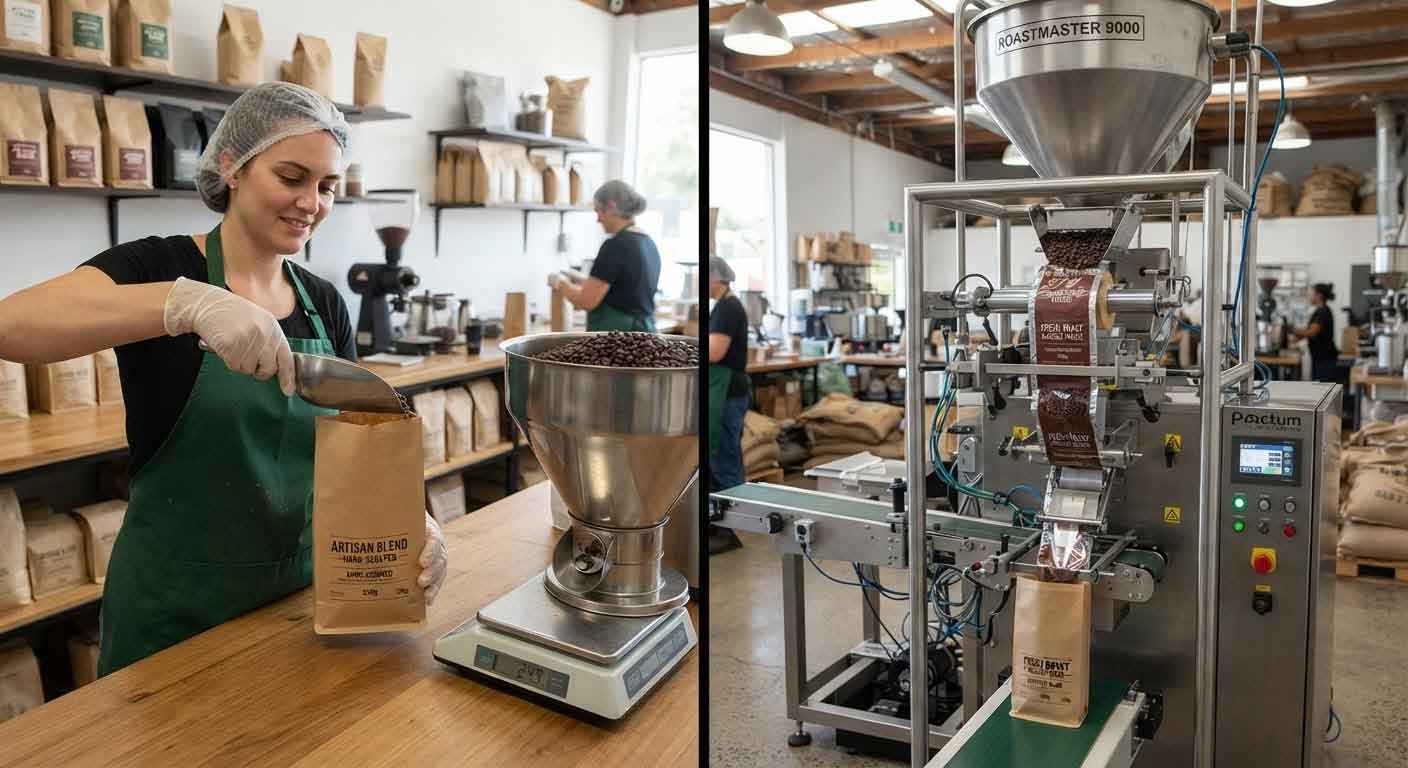
Hand filling looks cheap at first. But as orders grow, it slows you down and causes weight errors. The bag you choose should match your filling plan from day one.
If you fill coffee bags by hand, choose a bag with more headspace so you can scoop the coffee in easily. If you plan to grow, a packing machine is the better choice. Most modern coffee packing machines work with many bag styles and sizes.
What Are the Real Costs of Each Method?
Hand filling saves you money on machines. But it costs you in other ways. I have seen small roasters spend whole weekends filling bags by hand. Their output was low, and their weights were often off. The table shows the trade-offs.
| Factor | Hand Filling | Machine Filling |
|---|---|---|
| Start-up cost | Low | High |
| Output | Low | High |
| Weight accuracy | Not stable | Very stable |
| Room to grow | Limited | Large |
| Best packaging form | Pre-made bags with extra headspace | Pre-made bags or roll film |
What Materials Keep Coffee Fresh?
Coffee loses its aroma fast. Oxygen, moisture, and light all attack it every day. The wrong film means stale coffee long before the best-before date.
Good coffee bags use multi-layer barrier films. For high protection, I use PET/AL/PE or PET/EVOH/PE. For better value, I use PET/VMPET/PE or kraft paper structures. For eco goals, I offer compostable PLA films and recyclable mono PP or mono PE films.

What Numbers Should a Coffee Bag Meet?
Coffee is very sensitive. Ground coffee goes stale much faster than whole beans, because grinding exposes far more surface to oxygen. So I use these targets when I pick a film.
| Barrier Property | Whole Beans | Ground Coffee |
|---|---|---|
| Oxygen transmission rate (OTR) | ≤ 0.5 cc/m²·24h | ≤ 0.3 cc/m²·24h |
| Water vapor transmission rate (MVTR) | ≤ 0.5 g/m²·24h | ≤ 0.5 g/m²·24h |
| Light transmission | ≤ 5% | ≤ 5% |
Light roast beans are extra sensitive to light. So I take light blocking very seriously for those clients.
Which Material Structures Can I Choose?
| Goal | Material Structure | Thickness |
|---|---|---|
| High barrier | PET/AL/PE, PET/EVOH/PE | 130–180 μm |
| Good value | PET/VMPET/PE, MOPP/Kraft/VMPET/PE, Kraft/PET/AL/PE | 130–180 μm |
| Compostable, natural look | Kraft/VMPLA/PLA | 130–180 μm |
| Compostable, modern look | PLA/VMPLA/PLA | 130–180 μm |
| Recyclable mono PP | MOPP/VMBOPP/CPP | About 110 μm |
| Recyclable mono PE | MDOPE/EVOH/PE | About 110 μm |
What Is My Honest View on Eco Materials?
More brands now want recyclable or compostable bags. I support this. But I always tell clients the truth. Compostable films do not block moisture, dust, and UV light as well as traditional films. So the shelf life is shorter. If you sell fast, they work well. If your coffee sits in a warehouse for months, I suggest a recyclable mono material instead.
Why Does a Coffee Bag Need a One-Way Valve?
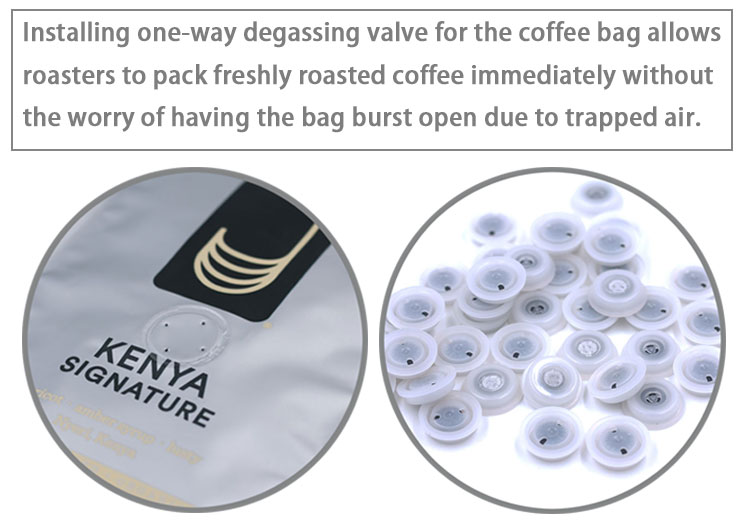
Fresh roasted beans keep releasing gas. Without a way out, the bag swells and may even burst. A one-way valve solves this problem.
A one-way degassing valve lets CO₂ out of the bag and keeps oxygen from getting in. Freshly roasted coffee releases a lot of CO₂, especially in the first days after roasting. The valve protects the bag shape and keeps the coffee fresh.
What Happens Without a Valve?
After roasting, coffee beans keep releasing CO₂ for 15 to 20 days or more. If the bag is fully sealed, the gas builds up. The bag puffs up and may burst. The trapped gas can also hurt the flavor. Skipping the valve to save cost is risky: sealed bags of fresh coffee can arrive swollen.
What Opening Pressure Should I Choose?
The valve opens at a set pressure. I choose this pressure based on how you ship.
| Shipping Method | Suggested Opening Pressure | Reason |
|---|---|---|
| Land or sea | About 2.0 mbar | Air pressure stays stable |
| Air | 2.5 mbar or higher | Air pressure changes during flight |
Where Should the Valve Go?
I can place the valve high or low on the bag. It depends on your design and your fill level. The valve should stay above the coffee, so it can release gas freely. If you only pack whole beans or only ground coffee, I use a valve made for that type. If you pack both, I use a multi-use valve. This keeps your ordering simple.
How Do I Choose the Right Coffee Bag Size?
"I need a one-pound bag" sounds clear. But one pound can fit many shapes. A wrong size leaves your bag too empty or too tight.
A coffee bag size has three parts: width, height, and bottom or side gusset. To choose the right size, I look at the bag style, the bean type, and the roast level. I also ask how much space you want above the coffee. Testing samples is the safest way.

What Are the Common Sizes?
These are the sizes I use most. The format is width × height + gusset. Note: 1 oz ≈ 28.35 g.
| Bag Style | Capacity | Size (mm) |
|---|---|---|
| Flat bottom bag | 250 g | W110 × H190 + 2×40 |
| Flat bottom bag | 500 g | W125 × H250 + 2×45 |
| Flat bottom bag | 1000 g | W145 × H340 + 2×45 |
| Side gusset bag | 250 g | W80 × H280 + 2×25 |
| Side gusset bag | 500 g | W105 × H340 + 2×33 |
| Side gusset bag | 1000 g | W130 × H420 + 2×38 |
| Side gusset bag | 2500 g | W170 × H500 + 2×55 |
| Stand-up pouch | 28 g | W80 × H130 + 2×25 |
| Stand-up pouch | 70 g | W110 × H170 + 2×30 |
| Stand-up pouch | 100 g | W120 × H200 + 2×35 |
| Stand-up pouch | 150 g | W130 × H210 + 2×40 |
| Stand-up pouch | 250 g | W160 × H230 + 2×45 |
| Stand-up pouch | 500 g | W190 × H275 + 2×50 |
| Stand-up pouch | 1000 g | W240 × H335 + 2×60 |
Why Is the Same Weight Not the Same Size?
Dark roast beans are larger and lighter than light roast beans. So one pound of dark roast needs more space. The bean variety also changes the volume. Your design taste matters too. Some brands like a lot of space above the coffee. Others want the bag just full.
How Do I Help Clients Decide?
I send sample bags in different styles and sizes. The client fills them with real coffee. Then the client tells me which one looks and feels right. This step takes a few days. But it saves a lot of money and stress later.
Which Closure Option Should I Pick?
Once a customer opens the bag, freshness starts to drop fast. A poor closure means stale coffee in their kitchen. The right closure keeps your coffee tasting fresh.
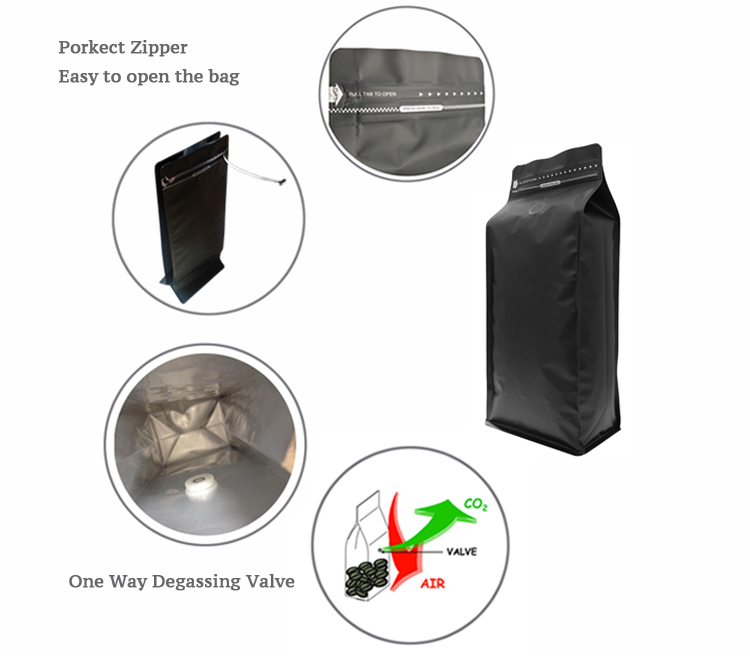
The main coffee bag closures are tin ties, pull tab zippers, and one-way valves. Tin ties suit a classic look. Pull tab zippers are easier to fill and keep coffee fresh longer. Valves release gas. I often combine them on one bag for the best result.

How Do the Closures Compare?
All my bags work for ground coffee, whole beans, roasted coffee, and green coffee. The closure is about how your customer uses the bag at home.
| Closure | How It Works | Strengths | Best Bag Style |
|---|---|---|---|
| Tin tie | Roll the top down and fold the wire tabs | Classic look, simple to use | Side gusset, flat bottom |
| Pull tab zipper | Tear the top, then press the zipper closed | Easy filling, longer freshness, no loose ties | Flat bottom, stand-up pouch |
| One-way valve | Releases CO₂, blocks oxygen | Prevents swelling, protects flavor | All coffee bags |
Why Do Small Roasters Love Pull Tab Zippers?
Pull tab zippers are now the most popular choice for small roasters. They make loading easier. They also keep coffee fresh longer than tin ties. My clients tell me they no longer deal with tin ties falling off. They also save time because they do not need to apply ties by hand.
Are Zippers Shipped Open or Closed?
I ship stand-up pouches with the zipper closed. This keeps the inside clean during transit. It also protects the bags from dust and dirt. If your filling line needs open zippers, just tell me. I can supply them on request.
How Can I Make My Coffee Bag Stand Out?
Many coffee bags look the same on the shelf. Buyers walk past them in seconds. Smart printing and finishes give your bag a reason to be picked up.
To make a coffee bag stand out, I use custom logos and artwork, matte or glossy finishes, spot UV, embossing, and foil stamping. I also help clients choose between digital printing and gravure printing. The right choice depends on your order size, budget, and color needs.

Which Printing Method Fits My Order?
I offer two printing methods. Each one has a clear use.
| Factor | Digital Printing | Gravure Printing |
|---|---|---|
| Plate cost | None | Yes, one-time cost |
| Unit price | Higher | Lower at large volume |
| Color effect | Rich and bright | Stable and consistent |
| Best order size | Small runs, many designs | Large runs, fixed designs |
| Lead time | As fast as 10–12 working days | Longer |
Which Finishes Work Best?
Kraft paper with a simple logo gives a natural, craft look. Full color with a matte finish feels modern and soft. Spot UV and foil stamping add shine to your logo. Embossing adds a feel that buyers can touch. I often mix two finishes to make a logo pop.
Should I Add a Clear Window?
Some roasters add a window to show the beans. But a window lets UV light reach the coffee. This hurts the flavor. So I usually do not recommend it. If you really want a window, I suggest a small one with a UV-blocking film.
What If I Need Design Help?
You do not need print-ready files. I can take your raw artwork and set it up for barrier film printing. Then I send you a digital proof to review and change.
How Does Custom Coffee Packaging Work With Sorbar?
Many buyers worry about slow samples, high MOQs, and unclear prices. These problems waste time and money. A simple, clear process takes that worry away.
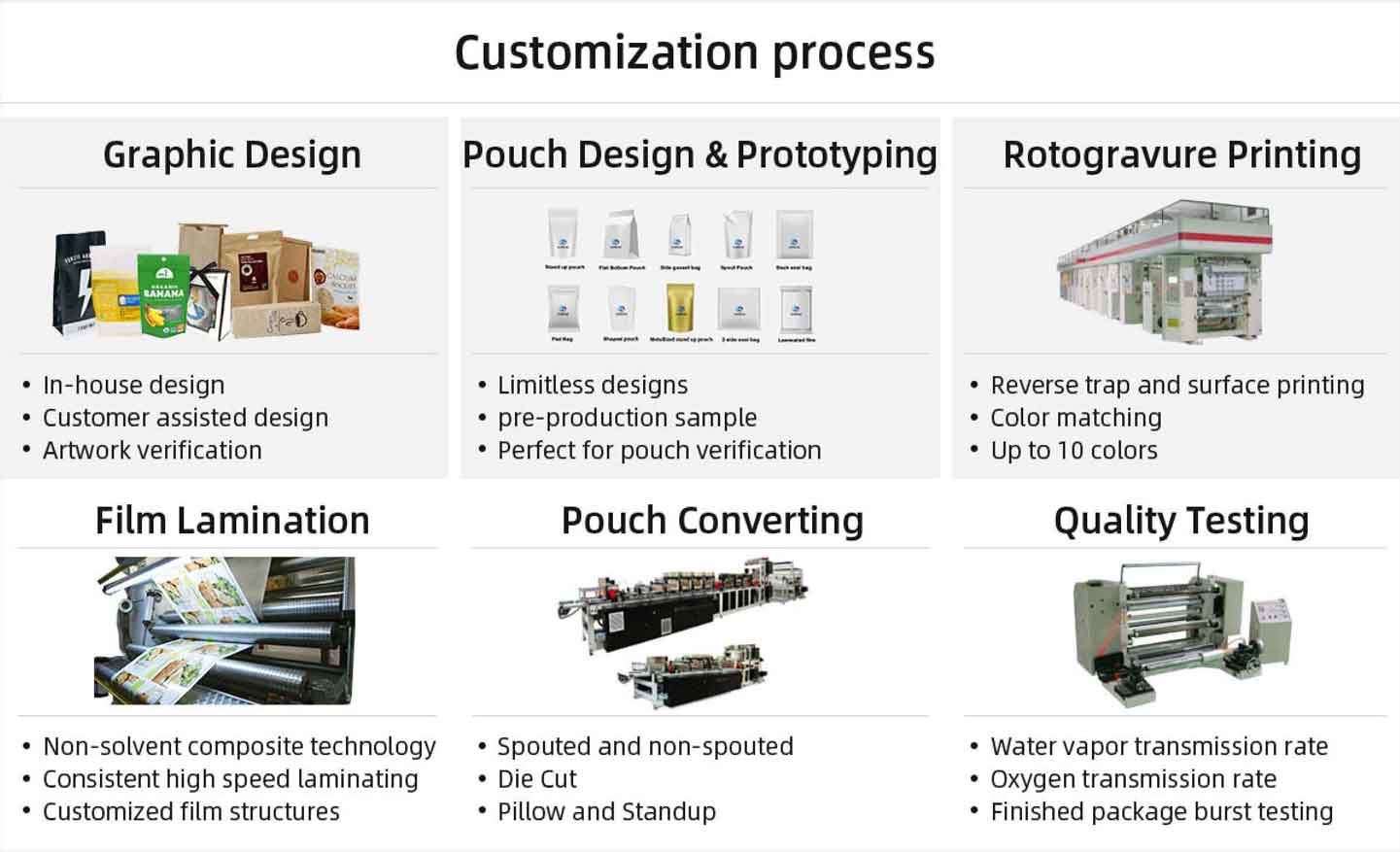
At Sorbar, custom coffee packaging takes four simple steps: talk with us, design and sample, confirm and produce, then inspect and ship. Small orders start at 1,000 pieces. Bulk orders start at 10,000 pieces. Digital printing can ship in as fast as 10–12 working days.
What Are the Four Steps?
| Step | What I Do | What You Do |
|---|---|---|
| 1. Talk and plan | I learn your product, budget, quantity, and goals | Contact me by phone, email, or website |
| 2. Design and sample | I confirm design, material, and finishes, then send a quote and a physical sample | Review and approve |
| 3. Confirm and produce | I start production and share progress updates | Track your order |
| 4. Inspect and ship | I run strict quality checks, then pack and ship worldwide | Receive your bags |
What Is the MOQ?
Small orders start at 1,000 pieces. They are good for testing and trial runs. Bulk orders start at 10,000 pieces. They suit roasters who sell coffee year round. I offer wholesale pricing on every order. I also make custom sizes, so you are not stuck with standard options.
What Decides the Price?
The price depends on the bag style, the design, the number of colors, the material, and the thickness. The biggest factor is the order quantity. Because every order is custom, I can plan materials and machine time well. This cuts waste and lowers your cost. Send me your needs, and I will give you a first quote quickly.
Conclusion
The right coffee bag needs the right style, barrier film, valve, size, closure, and printing. Get these right, and your coffee stays fresh and sells better.