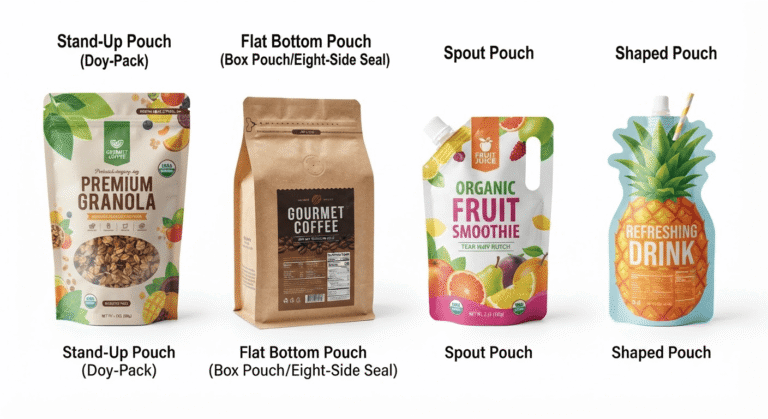
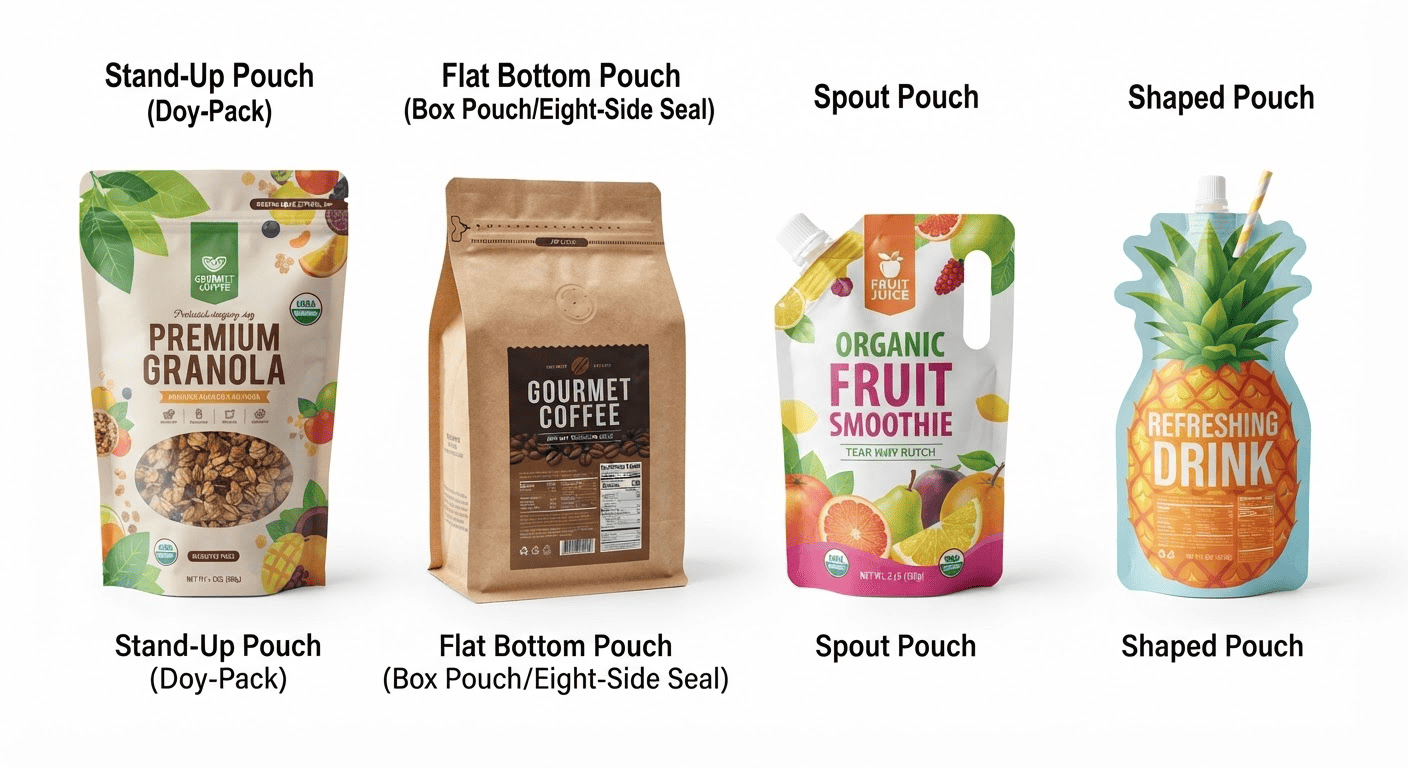
A stand-up pouch is a flexible package engineered to stand upright on its own base once filled. This capability comes from its gusseted (folded) bottom, which expands as the pouch is filled and provides a stable footprint. The structure allows the pouch to hold its shape after filling while remaining flexible enough for efficient storage and transport. Choosing the right pouch format directly affects logistics efficiency, shelf presence, and overall product protection.
1. What Is a Stand-Up Pouch?
A stand-up pouch — also known as a doypack — is a type of flexible packaging designed to stand upright on its own base when filled. The upright stability is achieved through a gusseted bottom, which is the feature that distinguishes it from other flexible formats such as flat or pillow pouches.
2. Common Applications
2.1 Food
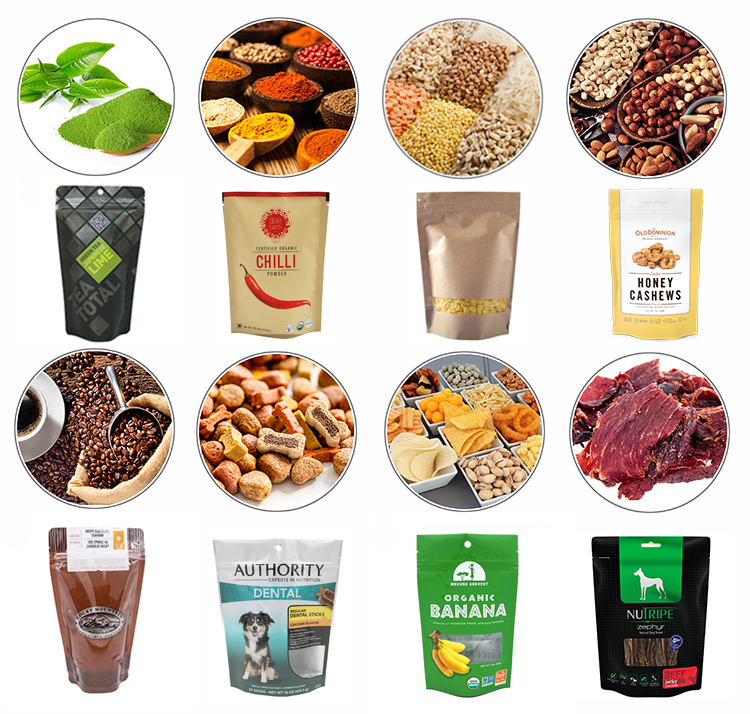
Stand-up pouches are widely used across the food industry for snacks, coffee, tea, sauces, baby food, and pet food. They offer consumers a convenient, resealable format and help extend the shelf life of perishable products.
2.2 Beverages
The format is well suited to liquid products such as juices, energy drinks, and flavored beverages. Reliable seals and high barrier performance prevent leakage and preserve freshness.
2.3 Health and Nutrition
For protein powders, vitamins, and dietary supplements, stand-up pouches provide effective protection against moisture and contamination, safeguarding product integrity.
3. Key Advantages
- Self-standing presentation — The bottom gusset allows the pouch to stand unaided, improving shelf visibility and ease of handling.
- Generous branding area — Large printable surfaces accommodate bold graphics, marketing messages, and detailed product information.
- Format flexibility — The expandable bottom accommodates a wide range of product shapes and sizes while using less packaging material than rigid alternatives.
- Strong product protection — Multi-layer laminates with sealed side and bottom seams deliver leak resistance and structural integrity, while blocking moisture, oxygen, and light to maintain freshness and quality.
- Logistics efficiency — The compact, lightweight structure optimizes storage and shipping, reducing overall logistics costs.
4. How to Choose the Right Stand-Up Pouch
4.1 Product Form and Characteristics
Stand-up pouches suit a broad range of product states:
- Liquids and pastes — beverages, sauces, hand soap
- Powders — flour, protein powder, ground coffee
- Solids, granules, and pieces — nuts, pet food, confectionery
4.2 Shelf Life and Barrier Requirements
Products that require extended shelf life — such as jerky, coffee, and oxidation-sensitive foods — demand higher barrier performance. The main factors that shorten shelf life are UV radiation, humidity and water vapor, and atmospheric oxygen. Barrier selection therefore has a direct impact on achievable shelf life.
4.3 Storage and Transport Conditions
Ambient temperature and humidity, stacking pressure, and transport methods all influence film thickness and laminate structure. Beyond protecting the contents, the pouch must withstand the physical and chemical stresses of the distribution environment.
4.4 Shelf Appeal and Brand Presentation
The pouch surface supports high-quality printing, while a well-engineered bottom determines standing stability and load-bearing capacity. Adding a transparent window further strengthens shelf appeal.
4.5 Safety and Compliance
For sensitive categories such as food and pharmaceuticals, material safety is critical. Materials must comply with the relevant regulatory standards to ensure no risk to the product or the end user.
4.6 Sustainability
As environmental awareness grows, both consumers and brands increasingly evaluate packaging on sustainability. Choosing recyclable, compostable, or otherwise eco-friendly materials strengthens brand image and market competitiveness.

5. Pouch Components and Configuration
5.1 Questions to Answer First
Depending on the application, a stand-up pouch can be fitted with a variety of components. Before specifying them, consider:
- Will the pouch hold a liquid or a solid?
- Will it stand on a shelf or hang from a display?
- Does it need to be resealed and reused after opening?
- Must the contents be visible at the point of sale?
- Is the product aroma-sensitive, such as coffee?
- Do the product's weight and volume require a specific bottom construction?
5.2 Available Components
| Component | Function |
|---|---|
| Spout | Enables controlled pouring and drinking; the key decision point for liquid products |
| Hang hole | Allows the pouch to be hung on display hooks or pegs |
| Zipper | Reseals the pouch for repeated use |
| Window | Lets customers see the shape, color, and texture of the product inside |
| One-way valve | Releases carbon dioxide (CO₂) while blocking outside oxygen and moisture from entering |
5.3 Bottom Styles
- Doyen bottom — A single smooth U-shaped or curved bottom seal. Best suited to lightweight products, typically under 1 lb (450 g).
- K-seal bottom — Features an angled seal on each side of the base; together with the horizontal bottom seal, the seams form the shape of the letter "K." Best suited to medium-weight products, typically 1–5 lbs.
6. Common Materials
Stand-up pouches can be produced from many material combinations. The structure chosen affects tactile feel, print quality, food compatibility, and recyclability.
6.1 Multi-Layer Laminates
| Structure | Characteristics | Typical Applications |
|---|---|---|
| PET / PE | The most widely used option. The PET layer provides stiffness and clarity; the PE layer provides heat sealing. Medium barrier, best value for money. | Milk powder, yogurt, instant drink powders |
| PET / AL / PE (foil laminate) | Highest barrier performance — light-proof, moisture-proof, oxidation-proof. Costs 20%–30% more than standard laminates. | Premium milk powder, freeze-dried dairy, long-shelf-life products |
| NY / PE | High toughness and puncture resistance, preventing damage in transit. | Dairy products containing particles, such as cereal milk powder or cheese granules |
| PET / AL / CPP | Retort foil pouch. Replacing the inner PE with CPP allows sterilization at 121°C. | Cooked meats, soft-canned foods |
6.2 Mono-Material Structures
Mono-material constructions support the recyclability of stand-up pouches, provided the entire package design is compatible with the target recycling stream. When assessing compatibility, components such as zippers must also be taken into account. The most common mono-material option is mono-PE.
MDOPE film — a high-stiffness PE substrate produced by the MDO (machine-direction orientation) process — offers excellent rigidity, clarity, puncture resistance, and heat resistance. It enables PE-to-PE lamination, making it possible to create flexible packaging composed of 100% polyethylene. Because no separation of different plastics is required during recycling, process complexity is greatly reduced. This innovation overcomes the long-standing recycling limitations of conventional mixed-material laminates and represents a major step forward in flexible packaging technology.
6.3 Compostable Materials
Kraft paper / PLA is one form of fully compostable laminate. Kraft paper is fully biodegradable, and PLA — a polylactic-acid bio-based resin derived from corn starch — can be broken down by naturally occurring microorganisms into water, carbon dioxide, and methane. The combination is therefore environmentally friendly while delivering the tactile quality of a traditional kraft paper bag, with pouches that are flat and stand firmly.
Kraft paper / PLA pouches are suitable for non-moist products such as tea, coffee beans, and nuts. A shelf life of no more than eight months is recommended; in a supermarket environment with low microbial activity, stable temperature, and low humidity, the pouch itself can remain intact for approximately 12 months.

7. Frequently Asked Questions
What is a stand-up pouch? A stand-up pouch (also known as a doypack) is a type of flexible packaging designed to stand upright on its own base when filled. It stands upright with the help of a gusseted bottom — the feature that sets it apart from other pouch types.
How much does a stand-up pouch cost? Pricing depends on material, size, style, and order quantity, and generally ranges from USD 0.025 to USD 1.30 per pouch.
What is the minimum order quantity for printed stand-up pouches? Digital printing: MOQ 1,000 pcs. Gravure printing: MOQ 10,000 pcs.
Are stand-up pouches suitable for food? Yes. The multi-layer structures typically used — combining PET, aluminum foil, and PE — provide excellent barrier performance against moisture, air, and light, offering maximum food protection. They are flexible, cost-effective, and widely used across all food categories.
What does "mono-material" mean? It means that more than 95% of the package's mass comes from a single polymer family (for example, all-PE or all-PP). No separation is needed at end of life: the package can go directly into the corresponding recycling stream and be fully re-pelletized after shredding.
Are zippers shipped open or closed? For hygiene reasons, and to ensure the pouches remain free from contamination during transit, our stand-up pouches are always shipped with the zipper closed. Pouches with open zippers can be supplied on request.
What is flexible packaging? Flexible packaging refers to thin, lightweight, easily formed packaging. It is typically made from metal foil or plastic and can be used for a very wide range of products. Pillow pouches such as potato chip bags and energy bar wrappers are common examples.