Many buyers ask me for green packaging. Then they pick the wrong material and waste money. The fix is simple. You need to define what "green" means for your product first.
No single material is always the most eco-friendly. Mono-material pouches are best for recycling. High barrier pouches cut food waste with a long shelf life. Plant-based materials work only where composting exists. The right choice depends on your goal, your product, and your local recycling system.

Over the years, many customers have asked me the same question. "I want eco-friendly packaging. What material do you suggest?" I always ask one question back. What do you mean by "eco-friendly"? Do you want it to be recyclable? Do you want low carbon? Do you want it to feel like paper? Or do you only want it to look green? These answers lead to very different materials. I think the biggest trap is this. Many people believe "eco-friendly" has only one standard. It does not. Let me show you how I break this down, step by step.
Is Plastic-Free Packaging Always Better for the Environment?
Many brands rush to drop plastic. They think this makes them green. But this move can raise carbon and food waste. I want to explain why.
No. Plastic itself is not the problem. The real problems are wrong use, poor disposal, and weak recycling systems. A well-designed 100% recyclable PE pouch can have a lower carbon footprint than a paper bag. Paper uses more water and energy, and it keeps food fresh for less time.

Plastic Is Not the Real Enemy
I will say something that may upset some people. Plastic is not the original sin. The real issue is how we use it. People use it in the wrong places. People throw it away in the wrong way. Many cities also lack good recycling. These three things cause the harm.
Why Paper Is Not Always Lower Carbon
Paper looks greener, but it is not always the lower-carbon choice. For moisture-sensitive products such as tea, a paper bag usually lets in more moisture than a PE pouch. The product loses flavor faster and more stock goes to waste, so the total carbon footprint can end up higher.
| Factor | Recyclable PE Pouch | Paper Bag |
|---|---|---|
| Water use in production | Low | High |
| Energy use in production | Medium | High |
| Freshness protection | Good | Weak |
| Product waste risk | Low | Higher |
| Looks "natural" | No | Yes |
The Role Matters More Than the Name
I tell my clients one thing again and again. The name of the material is not the key. The key is the role it plays in the whole chain. A material can look green and still do a poor job.
Is Mono-Material Packaging the Best Choice for Recycling?
Mono-material pouches sound like the perfect answer. Many clients ask for them first. But I have seen them fail when the product needs strong protection.
Mono-material packaging, like all-PE or all-PP pouches, is the easiest to recycle. It has only one plastic type, so it can go straight into recycling lines. But it has a weaker barrier to oxygen and moisture. It does not suit products that need a long shelf life.

Where Mono-Material Works Well
A mono-material pouch has a clear green point. The recycling path is simple. Laminated films need different layers pulled apart. A mono-material film does not. It can go right into a recycled plastic line. This gives it high recycling value.
Where It Falls Short
The problem is real. Oxygen and water vapor can get in more easily. Snacks, milk powder, and pet food often need a long shelf life. A basic mono-material pouch cannot always protect them.
| Product Type | Shelf Life Need | Mono-Material Fit |
|---|---|---|
| Dry goods for fast sale | Short | Good |
| Frozen food | Medium | Good |
| Crispy snacks | Long | Weak |
| Milk powder | Long | Weak |
| Pet food | Long | Weak |
My Warning to Buyers
I had a snack client who chose an all-PE pouch to be "green." After two months, the chips went soft. The client had to throw away a full batch. I call this putting the cart before the horse. You should not make a mono-material pouch do a high barrier job. Spoiled food creates more carbon than the pouch saves.
Are Multi-Layer High Barrier Pouches Really Bad for the Planet?
Many people see the word "laminated" and think "bad for the earth." This idea is unfair. It can push brands toward packaging that lets food spoil faster.
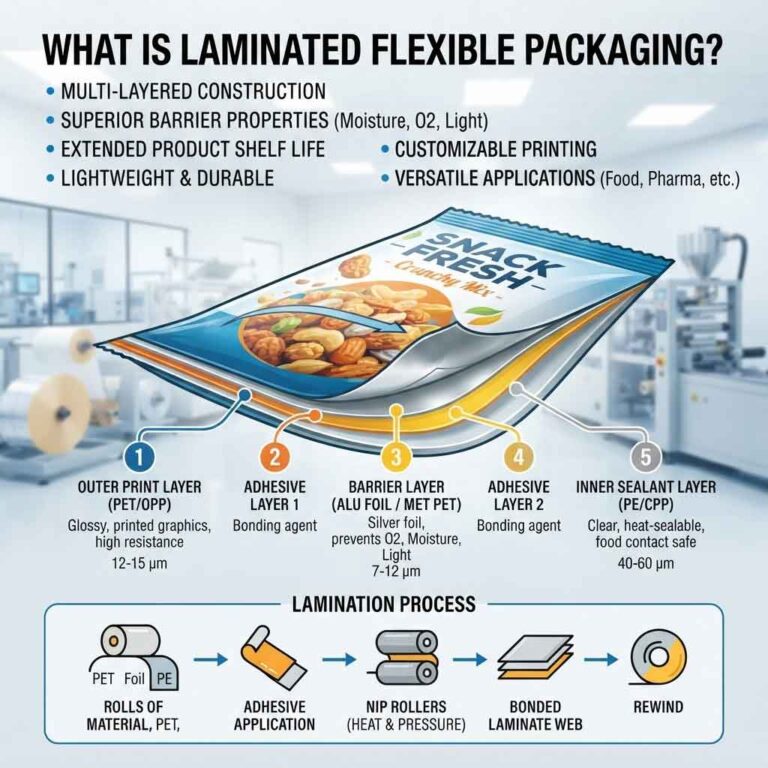
Not always. Multi-layer structures like PET/AL/PE or films with EVOH give strong protection. They can extend shelf life from 3 months to 12 months. This means fewer shipments and less expired food. Food waste often creates more carbon than packaging. So these pouches can be greener overall.

The Hidden Value: Less Food Waste
I think high barrier pouches are often blamed by mistake. People forget their biggest value. They keep food fresh. A longer shelf life means fewer trips by truck. It also means less food goes to the trash. Around the world, the carbon from wasted food is often several times higher than the carbon from packaging. A laminated film that cuts food loss can be a good deal over the full life cycle.
The Real Weakness: Hard to Recycle
I will be honest. Laminated films are hard to recycle. The layers are made of different materials. Most recycling lines cannot separate them.
Where the Industry Is Going
At Sorbar, we watch these changes closely. We also test new structures for our clients. The industry is moving in three main directions.
| Direction | What It Means | Goal |
|---|---|---|
| Aluminum-free | Replace foil with coated films | Easier to recycle |
| High barrier mono-material | Add barrier to PE or PP | Keep freshness and recycling |
| Chemical recycling | Break plastic down to raw material | Handle mixed layers |
I see these steps as a bridge. They help "freshness" and "recyclable" shake hands, one step at a time.
Is Plant-Based Packaging as Green as It Looks?
Plant-based packaging tells a great story. Brands love it. But I have seen beautiful compostable bags end up in landfills with normal trash.
Not always. PLA, bagasse, bamboo fiber, and paper look natural and green. But PLA needs industrial composting, which most cities lack. Paper uses lots of water and energy. Large crops for packaging can also cause land, water, and pesticide problems. It works only where local systems can handle it.

A Good Story vs. A Good Ledger
Brands love to tell the plant-based story. It sounds biodegradable. It sounds renewable. It feels natural in the hand. I understand the appeal. But a good story needs a good ledger behind it. I always ask my clients to check the numbers.
| Common Belief | The Real Fact |
|---|---|
| PLA breaks down anywhere | PLA needs industrial composting |
| Paper is always low carbon | Paper uses lots of water and energy |
| Paper keeps food fresh | Paper has a weak barrier |
| Plants are always green | Large crops can cause land and water problems |
It Depends on the City
Compostable bags only help when an industrial composting plant can take them. If they end up in a landfill, they are not very different from normal plastic. A plant-based pouch can only close the loop when the local system can process it.
Why LCA Matters
I use one tool to judge all three options. It is called LCA, or Life Cycle Assessment. It looks at every step. These steps include raw material, production, shipping, use, and recycling. Each step changes the final result. If you only look at the material name, you can fall into a trap.
How Should Buyers and Brands Choose Eco-Friendly Packaging?
A vague goal leads to a costly pouch. I see this mistake every month. Three simple rules can help you avoid it.
First, define your goal: recyclable, low carbon, or compostable. Second, fix the pouch design before you change the material. Third, check your local recycling and waste systems, not just the label. These three steps help you pick packaging that is truly green.
Tip 1: Define Your "Eco-Friendly" First
You need to choose one main goal. Do you want it recyclable? Do you want low carbon? Do you want it compostable? These goals can fight with each other. If your goal is not clear, your supplier can only give you the safest option. That option is often the most expensive one. It is not always the right one.
| Your Main Goal | Better Choice | Watch Out For |
|---|---|---|
| Easy to recycle | Mono-material PE or PP | Weak barrier |
| Low total carbon | High barrier pouch | Hard to recycle |
| Compostable | PLA or paper-based | Needs composting plant |
Tip 2: Do Not Let Material Pay for Bad Design
I see many pouches that are too big. I see extra layers that only look nice. I see inner liners with no real use. These are not green with any material. You should make the pouch right first. Then you can make the material green.
Tip 3: Check the Recycling System, Not the Label
A bag may say "biodegradable." But if it ends up in a landfill, it is close to normal plastic. If the local system cannot accept it, the "green" claim only makes us feel good.
Conclusion
There is no single green answer. Mono-material, high barrier, and plant-based are tools for different jobs. Packaging is not a moral test. It is an engineering problem.
References
- Plastic, Paper or Cotton: Which Shopping Bag is Best?, State of the Planet, Columbia Climate School, 2020.
- Cereal and Confectionary Packaging: Background, Application and Shelf-Life Extension, Foods, 2022.
- Multilayer Packaging in a Circular Economy, Polymers, 2022.
- Comprehensive analysis of bioplastics: life cycle assessment, waste management, biodiversity impact, and sustainable mitigation strategies, PeerJ, 2024.
- The Life Cycle Assessment for Polylactic Acid (PLA) to Make It a Low-Carbon Material, Polymers, 2021.
- ISO 14040:2006 Environmental management: Life cycle assessment, principles and framework, via U.S. Department of Energy.